

Reducing Material Substitution Errors with ERP Software for Manufacturing Industry in Oman
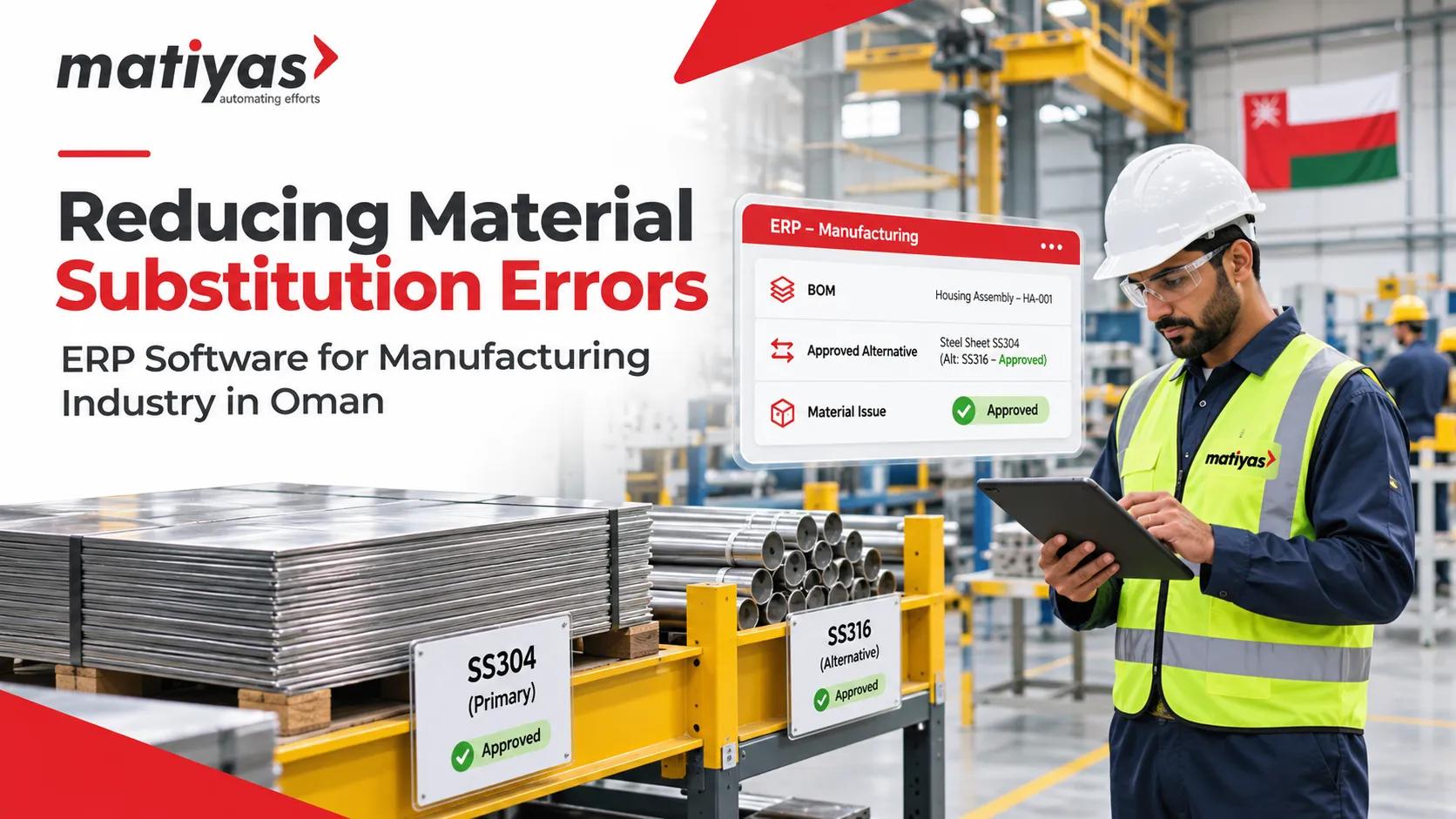
A production order may contain the correct product specifications, approved Bill of Materials (BOM) and planned quantities, but manufacturing problems can still occur when the wrong raw material is issued to the production floor.
For manufacturers in Oman, where industrial development increasingly emphasises modern technology, production efficiency and stronger local supply chains, controlling material usage is an important operational consideration. Oman's Ministry of Commerce, Industry and Investment Promotion has highlighted smart manufacturing, automation and supply-chain management as priorities under its Industrial Strategy 2040.
1. Understanding Material Substitution Errors in Manufacturing
Material substitution occurs when a manufacturer uses an alternative raw material, component or consumable instead of the item originally specified in a production requirement.
Substitution is not always a mistake. Manufacturers may legitimately use an alternative when the original material is unavailable, provided the replacement meets technical, quality and customer requirements.
The problem arises when the alternative is selected without proper verification or approval.
Without a documented approval process, the substitution can introduce defects that may only become visible during inspection, assembly or customer use.
2. Why Material Substitution Errors Matter for Omani Manufacturers
Manufacturing businesses operating in Oman may manage different suppliers, imported raw materials, local procurement, multiple warehouses and production requirements.
These activities make accurate material identification and coordination important.
Material substitution errors can create several operational problems:
Product quality issues: An alternative material may not meet the required technical specifications.
Production interruptions: Incorrect material issuance can force teams to stop work and arrange replacement stock.
Cost variations: Different materials may have different purchase prices, consumption rates and valuation costs.
Procurement complications: Buyers may reorder materials that are already available under another item code.
Inventory inaccuracies: Warehouse records may no longer reflect the materials actually consumed.
Customer specification risks: Products may fail to meet agreed requirements when substitutions are not authorised.
For example, food processing, metal fabrication, plastics manufacturing and industrial equipment production all have different material requirements. A substitution that is acceptable in one production process may be unsuitable in another.
3. Common Reasons Behind Material Substitution Errors
3.1 Similar material names and item codes
Materials with similar descriptions can easily be confused during purchasing, receiving or warehouse picking.
For example, two metal sheets may have similar dimensions but different thicknesses or grades. If item descriptions and identification codes are unclear, employees may select the wrong material.
3.2 Outdated Bills of Materials
A BOM defines the components and quantities required to manufacture a product.
When engineering teams update product specifications but purchasing and production continue using outdated BOM information, material requirements can become inconsistent.
3.3 Unauthorised production-floor decisions
Production employees may replace unavailable materials to maintain output. However, without documented approval, these substitutions can bypass engineering and quality checks.
3.4 Poor supplier communication
Suppliers sometimes propose alternative materials because of availability or delivery constraints. If purchasing teams accept these changes without obtaining the necessary technical approval, incorrect materials may enter inventory.
3.5 Disconnected inventory and production records
When procurement, warehouse and production teams use separate records, they may not have the same information about material availability, approved alternatives and actual consumption.
4. How ERP Software Prevents Material Substitution Errors
A manufacturing ERP system connects material planning, inventory, procurement, production and quality management through a common operational database.
This makes it easier to establish controls before an alternative material reaches the production process.
4.1 Maintain approved alternative material records
Manufacturers can maintain a controlled list of alternative materials associated with specific original items.
Each approved alternative should include relevant information such as:
Original material code.
Alternative material code.
Technical specifications.
Applicable products or production processes.
Approval status.
Effective date, where required.
Restrictions on usage.
For example, a manufacturer may approve an alternative packaging material for a particular product while restricting its use in other product categories.
4.2 Control material substitutions through BOM management
BOM management helps manufacturers maintain the correct material requirements for each finished product.
When engineering changes a material specification, the updated BOM should be reviewed and approved before it becomes applicable to new production orders.
A controlled BOM process helps businesses maintain consistency between:
Product specifications.
Required raw materials.
Component quantities.
Production operations.
Material procurement.
Work order requirements.
This reduces the risk of employees using outdated material instructions.
4.3 Connect inventory availability with production planning
Before creating or releasing a production order, the ERP system can help planners review available quantities of required materials.
If a specified material is unavailable, the purchasing team can evaluate procurement options or check whether an approved alternative exists.
This prevents production teams from relying on informal warehouse decisions.
4.4 Establish material approval workflows
Not every material substitution should be approved automatically.
Manufacturers should define approval responsibilities according to the material's technical importance.
For example:
Substitution requirement | Responsible department |
|---|---|
Material specification verification | Engineering |
Quality suitability | Quality control |
Supplier alternative evaluation | Procurement |
Production feasibility | Production management |
Final substitution authorisation | Designated manager |
The ERP system can support these approval stages through configured workflows, permissions and documented records.
4.5 Track actual material consumption
The planned material quantity and the actual material consumed should be compared for every production order.
If a production order requires 100 units of a specified component but the team issues an alternative material, the actual transaction should record the correct item code and quantity.
5. Important ERP Modules for Material Substitution Control
ERP module | How it helps |
|---|---|
Inventory Management | Maintains material codes, quantities and warehouse records. |
BOM Management | Defines approved product components and material requirements. |
Production Planning | Checks material requirements before production. |
Procurement Management | Connects supplier purchasing with approved material specifications. |
Quality Management | Supports incoming material inspections and quality verification. |
Work Order Management | Connects production instructions with actual material issuance. |
Reporting and Analytics | Highlights material consumption differences and substitution frequency. |
These modules should work together rather than operate as separate administrative functions.
6. Country-Specific Considerations for Manufacturing Businesses in Oman
Oman is developing its manufacturing sector through initiatives associated with Oman Vision 2040 and Industrial Strategy 2040.
For manufacturers, this creates a practical reason to review how material information moves between suppliers, warehouses, engineering teams and production departments.
An ERP implementation in Oman should consider:
Multi-warehouse material visibility.
Local and international supplier records.
Omani Rial (OMR) purchasing and inventory valuation.
English and Arabic item descriptions where operationally necessary.
Material specifications and supplier documentation.
Batch and serial tracking where required.
Quality inspection procedures.
Reporting that supports management decisions.
The system should also be configured around the manufacturer's actual products, production processes and applicable industry requirements. A standard material substitution workflow should not replace technical or regulatory approval where those approvals are required.
7. How ERPNext Supports Approved Material Substitutions
One practical example of ERP-based material substitution control is available in ERPNext.
ERPNext documentation describes an Item Alternative feature that allows manufacturers to define alternative items and use them in manufacturing when the original material is unavailable.
The functionality includes:
Creating alternative item relationships.
Enabling alternative material usage for specific items.
Allowing or restricting alternatives at BOM level.
Allowing alternative item selection in individual Work Orders.
Recording alternative material usage through Stock Entries.
These controls help manufacturers manage substitutions through system-recorded transactions rather than relying entirely on informal instructions.
Conclusion
Material substitution should never become an uncontrolled shortcut for maintaining production schedules. Even when an alternative component appears similar to the original, differences in technical specifications, quality and cost can create significant operational problems.
For manufacturing businesses in Oman, ERP software provides a structured way to manage approved alternatives, maintain accurate BOMs, monitor material availability and record actual production consumption.