

How Omani Businesses Can Prevent Stock Valuation Differences Between Warehouses and Accounts
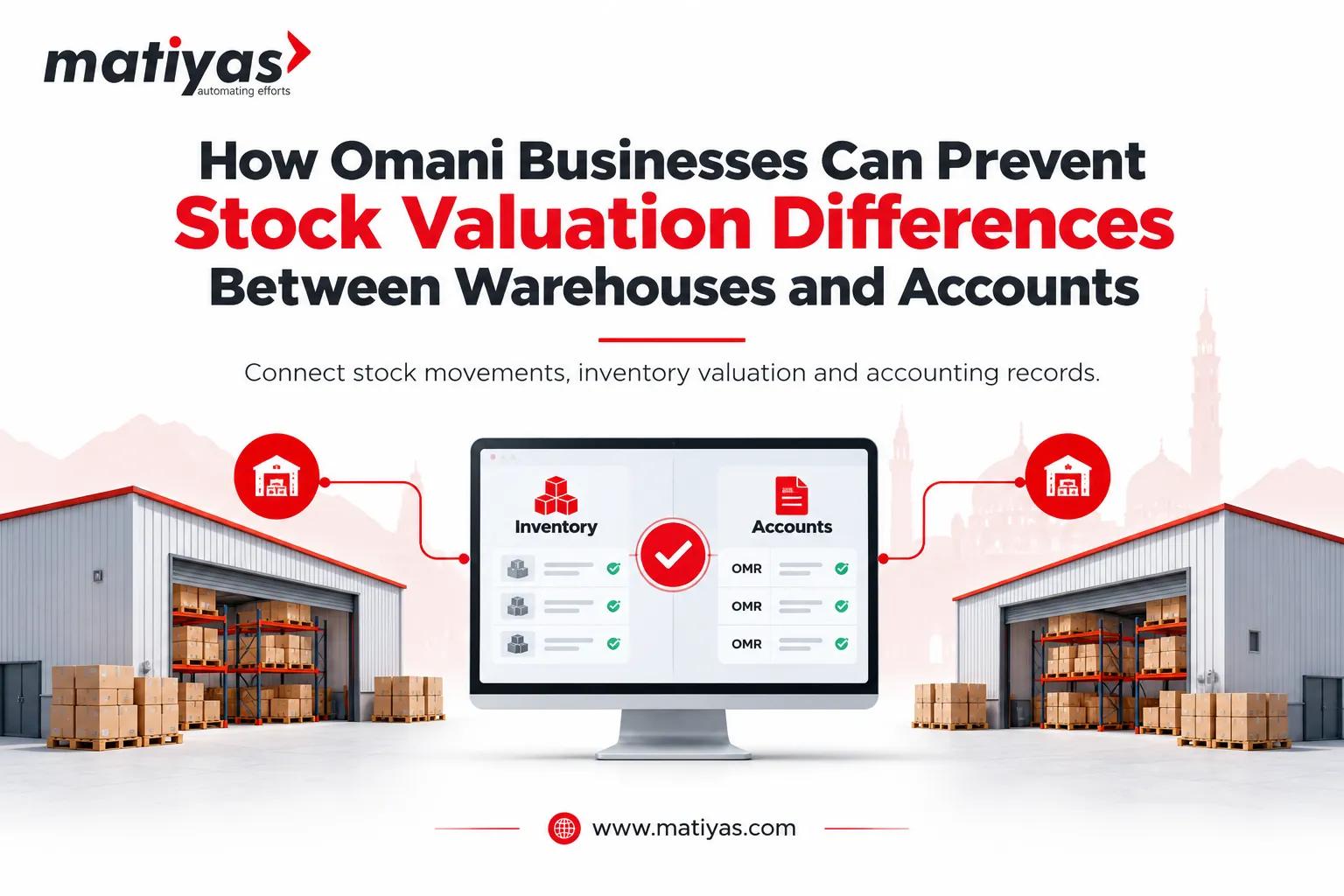
For businesses operating multiple warehouses, maintaining accurate inventory records is essential for purchasing, sales, financial reporting, and operational planning. However, many companies face a recurring challenge: the physical stock available in the warehouse does not match the quantity or value recorded in their accounting system.
For wholesalers, retailers, distributors, and manufacturers in Oman, these discrepancies can create uncertainty about inventory costs, product availability, and actual business performance. A warehouse may report sufficient stock while the finance team identifies a different inventory value in the accounts.
Implementing an ERP system in Oman can help businesses address these issues by connecting warehouse transactions, purchasing activities, inventory valuation, and accounting records through a consistent operational process.
Why Do Stock Valuation Differences Occur?
Inventory discrepancies do not always indicate missing goods. They can result from transaction timing, incomplete documentation, incorrect product quantities, or differences in how stock movements are recorded.
Common causes include:
1. Goods Received but Not Recorded Correctly
When a warehouse receives goods from a supplier, the physical quantity must be verified and recorded accurately. If the goods receipt is delayed, duplicated, or entered with an incorrect quantity, the inventory records may not reflect the actual stock position.
For example, a distributor receives 200 units but records only 180 units in the system. The remaining 20 units may exist physically without being reflected correctly in the inventory records.
2. Stock Transfers Between Warehouses
Businesses with multiple warehouses must maintain accurate records of stock leaving one location and arriving at another.
Suppose a company transfers 100 units from its Muscat warehouse to another storage facility. If the dispatch is recorded but the receiving transaction remains incomplete, the two warehouse balances may not reflect the actual movement.
A controlled transfer process should track dispatch, goods in transit, and receipt at the destination.
3. Differences in Inventory Valuation
Physical stock quantities and financial stock values measure different things. Even when the quantity is correct, the recorded value can differ because of incorrect item costs, supplier price changes, freight charges, duties, or inconsistent valuation methods.
For example, if 500 units are recorded at OMR 4 per unit, the expected inventory value is OMR 2,000. If the applicable unit cost should be OMR 4.20, the valuation difference is OMR 100.
Businesses must investigate whether the difference comes from an incorrect cost, an unrecorded expense, a transaction timing issue, or another accounting adjustment.
4. Delayed Sales, Returns, and Stock Adjustments
Stock may leave a warehouse before the related transaction is completed in the system. Customer returns, damaged products, expired goods, and production material consumption can also create differences when the physical movement and system entry are not recorded consistently.
Without a clear process, these small discrepancies can accumulate and become difficult to investigate at month-end.
How an ERP System in Oman Helps Connect Warehouse Stock and Accounts
An integrated ERP system connects inventory operations with the financial records generated by those operations. Rather than maintaining separate spreadsheets for warehouses and accounting, businesses can work from a shared set of transaction records.
1. Record Goods Receipts Against Purchasing Documents
A structured purchasing workflow links purchase orders, goods receipt records, and supplier invoices. Warehouse teams can verify quantities received, while finance teams can review the corresponding costs and outstanding supplier documents.
This makes it easier to identify partial deliveries, unrecorded receipts, and differences between ordered, received, and invoiced quantities.
2. Maintain Traceable Stock Transfers
An integrated system records stock leaving the source warehouse and arriving at the destination. Transfer status and goods-in-transit records help teams identify movements that have not been completed.
This is particularly valuable for distributors and retailers managing inventory across multiple branches or storage locations.
3. Apply Consistent Inventory Valuation
Inventory valuation should follow the company's configured costing method and applicable accounting policies. Depending on the system and configuration, methods such as FIFO or weighted-average costing may be used.
A connected inventory and accounting process helps ensure that stock movements generate the appropriate valuation and financial entries. It also allows finance teams to investigate changes in inventory value rather than relying solely on physical quantities.
4. Reconcile Inventory With the General Ledger
The inventory subledger and the general ledger should be reviewed together. Finance teams can compare inventory valuation reports with the corresponding accounting balances and investigate differences arising from incomplete postings, incorrect account mappings, timing issues, or manual adjustments.
Regular reconciliation makes discrepancies easier to identify before financial reporting deadlines.
5. Use Reports to Identify Recurring Problems
An ERP system can provide reports on stock balances, warehouse movements, inventory valuation, pending transactions, and adjustments.
These reports help managers identify which products, warehouses, or processes repeatedly generate discrepancies. Correcting the underlying process is more effective than repeatedly adjusting balances without investigating the cause.
Practical Steps Omani Businesses Can Take
Technology works best when supported by clear operating procedures. Businesses can strengthen inventory accuracy by following these practices:
Conduct regular stock counts: Compare physical quantities with system records and investigate material differences.
Define transaction responsibilities: Assign clear ownership for goods receipts, transfers, returns, and stock adjustments.
Control manual changes: Require appropriate approval and supporting documentation for inventory adjustments.
Review pending transactions: Check incomplete receipts, transfers, dispatches, and supplier invoices before closing the reporting period.
Standardise product records: Maintain consistent item codes, units of measure, and warehouse locations.
Reconcile inventory and accounts regularly: Investigate differences by transaction, quantity, cost, and posting date.
These controls help prevent unresolved discrepancies from carrying forward into subsequent reporting periods.
Choosing the Right ERP Solution for Your Business in Oman
Businesses evaluating an ERP solution should look beyond basic inventory tracking. The system should support their actual purchasing, warehousing, sales, manufacturing, and accounting workflows.
Important capabilities include multi-warehouse inventory management, traceable stock transfers, goods receipt processing, inventory valuation reports, accounting integration, approval controls, and management reporting.
Local business requirements should also be considered, including Omani accounting practices, applicable tax requirements, and e-invoicing requirements where relevant. These should be verified against current regulations and configured appropriately rather than assumed to be covered automatically by software.
Working with an experienced ERP implementation provider can help businesses map existing processes, configure the system, migrate accurate opening balances, and train employees to record transactions consistently.
Conclusion
Stock valuation differences between warehouses and accounts can affect purchasing decisions, financial reporting, and confidence in inventory data. The solution begins with understanding why discrepancies occur and establishing a reliable process for recording every stock movement and its financial impact.
For wholesalers, retailers, distributors, and manufacturers, an ERP system in Oman can help connect warehouse operations with accounting records, improve transaction traceability, and make inventory reconciliation more systematic.
Matiyas Solutions helps businesses explore ERP implementation and business process improvements tailored to their operational requirements. Learn more about ERP solutions for businesses in Muscat and across Oman: