

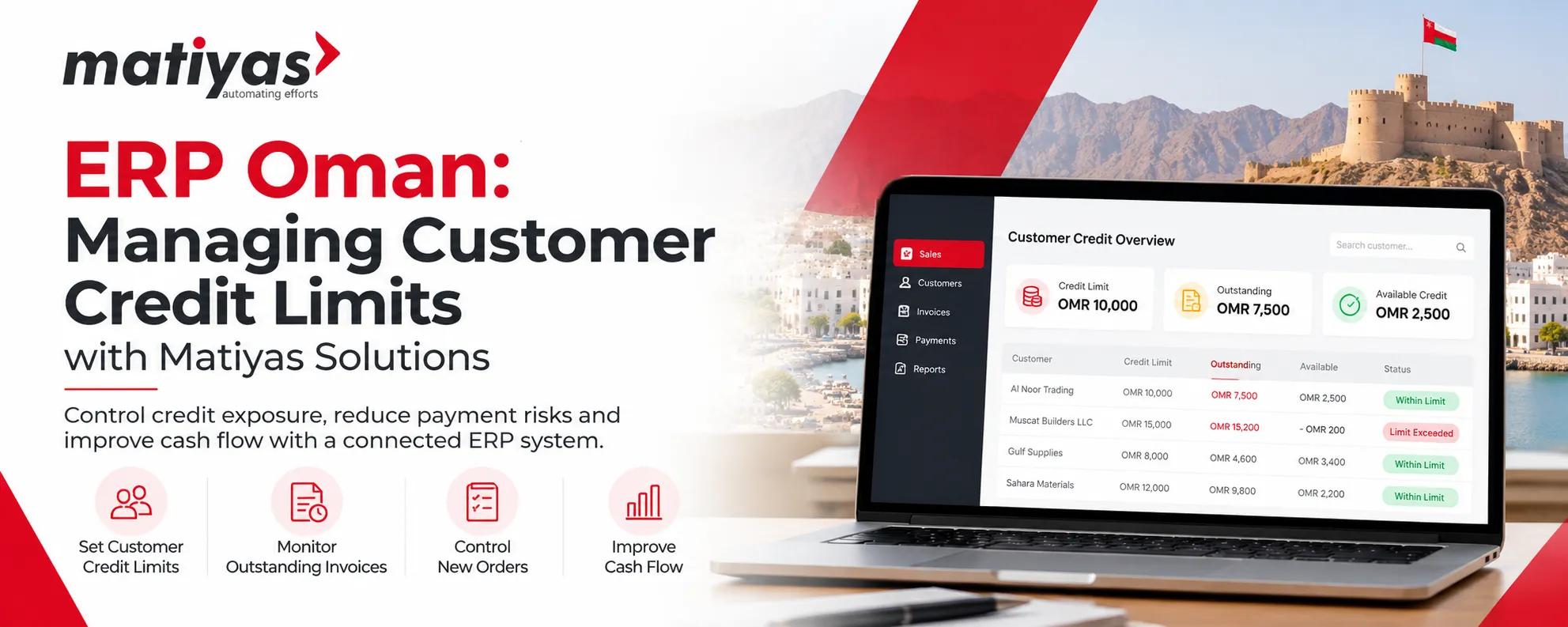
Businesses that provide goods and services on credit need a reliable way to manage customer balances, monitor outstanding invoices, and control additional sales. For wholesalers, distributors, and trading companies in Oman, uncontrolled credit exposure can create cash flow pressure and make it difficult to plan purchasing, inventory, and daily operations. When customer balances are maintained in separate spreadsheets or disconnected accounting systems, finance teams may not have the latest information when a new order arrives.
Matiyas Solutions helps businesses explore ERP implementation and customisation approaches that support better coordination between sales and finance. Understanding how credit controls work can help Omani businesses make informed decisions about their financial processes.
Understanding Customer Credit Limit Management
A customer credit limit is the maximum credit exposure a business is willing to accept for a particular customer under its approved credit policy. The limit may depend on the customer's payment history, purchasing frequency, financial assessment, and commercial relationship.
This decision becomes more difficult when the sales team cannot see current receivables or when payments have not been recorded promptly.
Customer credit management therefore requires more than setting a financial limit. Businesses need clear rules for calculating exposure, reviewing overdue invoices, approving exceptions, and communicating decisions to employees who process orders.
Why Customer Credit Control Matters for Businesses in Oman
Companies involved in wholesale distribution, industrial supplies, trading, and business-to-business sales may regularly extend payment terms to customers. Although credit can support commercial relationships, it also creates a responsibility to monitor outstanding balances.
Preventing excessive credit exposure
When sales representatives accept new orders without checking existing invoices, a customer's balance can exceed the company's intended limit. This may leave the business with more unpaid receivables than it planned to carry.
ERP-based credit checks can help identify transactions that need attention before additional commitments are approved.
Improving coordination between sales and finance
Sales teams focus on customer requirements and order fulfilment, while finance teams monitor invoices, payments, and receivables. If both departments use different records, they may reach different conclusions about whether a customer can place another order.
An integrated ERP system gives authorised employees access to more consistent customer and transaction information.
Identifying overdue accounts earlier
A customer who repeatedly pays late may continue receiving goods if the business has no defined process for reviewing overdue balances. Clear reporting and follow-up responsibilities help finance teams identify accounts that need attention.
Making approval decisions consistent
Without documented rules, credit exceptions may depend on individual employees. A structured approval process defines who can approve additional exposure, what information must be reviewed, and how the decision should be recorded.
How ERP Software in Oman Helps Manage Credit Limits
ERP software connects financial information with business transactions. Its usefulness depends on accurate records, suitable configuration, and clearly defined responsibilities.
1. Establish customer-specific limits
Businesses can define credit limits according to customer categories, payment behaviour, and internal risk assessments. A new customer may require a conservative limit, while an established account may qualify for different terms after a formal review.
Credit limits should be approved by authorised personnel and reviewed when a customer's circumstances or purchasing requirements change.
2. Review credit before accepting new orders
The sales order is an important point for checking whether a proposed transaction fits within the customer's available credit capacity.
Depending on the ERP platform and configuration, the system can flag or restrict transactions that exceed the applicable limit. This gives the business an opportunity to review the customer's outstanding balance before making further commitments.
Companies should decide whether checks apply at order submission, delivery, invoicing, or multiple stages of the sales process.
3. Connect invoices with payment records
A credit decision is only as reliable as the underlying accounting information. If a customer has paid an invoice but the payment has not been entered or allocated correctly, the system may show an inaccurate outstanding balance.
An integrated accounting workflow helps finance teams maintain invoice records, payment entries, credit notes, and customer balances in a connected environment.
4. Monitor overdue invoices
Credit limits alone do not explain the full financial position of a customer. A customer may remain within the approved limit while still having invoices that are significantly overdue.
Businesses should therefore review both total credit exposure and payment ageing. This helps managers distinguish between a customer who is using an approved credit facility responsibly and one whose payment behaviour requires further assessment.
5. Introduce controlled credit exceptions
Commercial flexibility is sometimes necessary. A customer may request additional supplies for a project or experience a temporary increase in demand.
Instead of permitting unrestricted overrides, businesses can define an exception procedure. The responsible manager can review the reason for the request, outstanding invoices, available credit, and expected payment before deciding whether to approve it.
ERP Modules That Support Credit Management
Customer credit management relies on several connected ERP functions.
Customer management: Maintains customer records, commercial details, and relevant credit information.
Sales management: Records quotations, sales orders, and transactions that may affect credit exposure.
Accounting and finance: Tracks invoices, payment entries, credit notes, and outstanding receivables.
Reporting and analytics: Helps managers review overdue accounts, customer balances, and credit utilisation.
Workflow and permissions: Supports approval responsibilities and controlled exceptions.
The availability of specific controls depends on the ERP platform, version, configuration, and any required custom development. Businesses should test their intended workflow before relying on it for operational decisions.
ERPNext Credit Limit Management
Businesses evaluating an ERP system in Oman can consider ERPNext as one possible option. ERPNext provides credit-limit functionality that can be configured at Customer, Customer Group, and Company levels.
Depending on the configuration, credit-limit checks can prevent submission of applicable Sales Orders or Sales Invoices when the relevant limit is exceeded. Businesses should verify how these controls operate with their customer records, transaction types, and user permissions.
For example, a distributor may configure customer credit limits and establish a procedure for reviewing orders that exceed the remaining capacity. Finance employees can investigate outstanding invoices, while designated managers handle exceptions according to the company's policy.
Before implementation, the business should establish how its chosen configuration treats open orders, submitted invoices, payments, and other transactions that may affect credit exposure. These details should be tested rather than assumed.
Practical Example: Credit Management at a Muscat Trading Company
Consider a trading company in Muscat that supplies electrical materials to contractors and retailers. One contractor has an approved credit limit of OMR 10,000 and an applicable outstanding exposure of OMR 7,500.
The contractor requests a new order worth OMR 3,000. If the full order value adds to the exposure measured by the company's credit policy, the resulting total would be OMR 10,500, exceeding the approved limit by OMR 500.
A configured ERP workflow can flag the transaction for review. The finance team can check the outstanding invoices and payment records before recommending an action. The company might request a partial payment, revise the order, or refer the exception to an authorised manager.
If a payment is subsequently received and recorded correctly, the available credit can be recalculated according to the configured rules.
This is an illustrative scenario rather than a reported customer result. It demonstrates how connected financial information can support consistent credit decisions without automatically rejecting every additional order.
Important Considerations for ERP Implementation in Oman
Businesses should review their existing processes before configuring credit controls.
First, customer records and opening receivables must be accurate. Incorrect balances can cause legitimate orders to be flagged or risky transactions to proceed.
Second, payment terms and credit policies should be documented. Employees need to understand how limits are approved, when accounts are reviewed, and who can authorise exceptions.
Third, businesses working with multiple currencies should define how credit exposure is calculated and reported. Currency conversion and transaction timing should be tested according to the selected ERP configuration.
Fourth, applicable invoicing and VAT processes should be reviewed separately. Credit-limit controls do not automatically guarantee compliance with Omani tax requirements. Businesses should consult the Oman Tax Authority's official guidance and obtain appropriate professional advice where necessary.
Finally, staff training is essential. Sales representatives should know how to respond when a transaction requires review, while finance teams must maintain accurate accounting records and follow established collection procedures.
How Matiyas Solutions Can Help
Matiyas Solutions supports businesses exploring ERP implementation, customisation, integration, and related business process improvements.
For companies in Oman, an assessment can identify gaps between sales operations and accounts receivable. Based on the business requirements, an implementation project may include customer credit configuration, sales approval workflows, financial reporting, data migration, and employee training.
The implementation approach should begin with the company's existing credit policy rather than introducing software controls without a clear business purpose. Standard platform functionality should be assessed first, with additional customisation considered when genuine requirements cannot be met through configuration.
Conclusion
Managing customer credit limits requires accurate accounting records, clear approval responsibilities, and visibility into how new orders affect outstanding exposure. Recording a credit limit without connecting it to sales and finance processes may not provide sufficient control.
For businesses in Oman, an appropriately configured ERP system can connect customer accounts, sales orders, invoices, payments, and reporting. This helps employees identify transactions that need review and gives management a clearer basis for credit decisions.
Matiyas Solutions can help businesses assess their requirements and explore ERP implementation approaches that support structured credit management. The goal is to balance customer relationships, sales continuity, and financial discipline through a consistent business process.