

Cloud ERP in Oman: Connecting Peppol Invoices with Accounting and Business Records
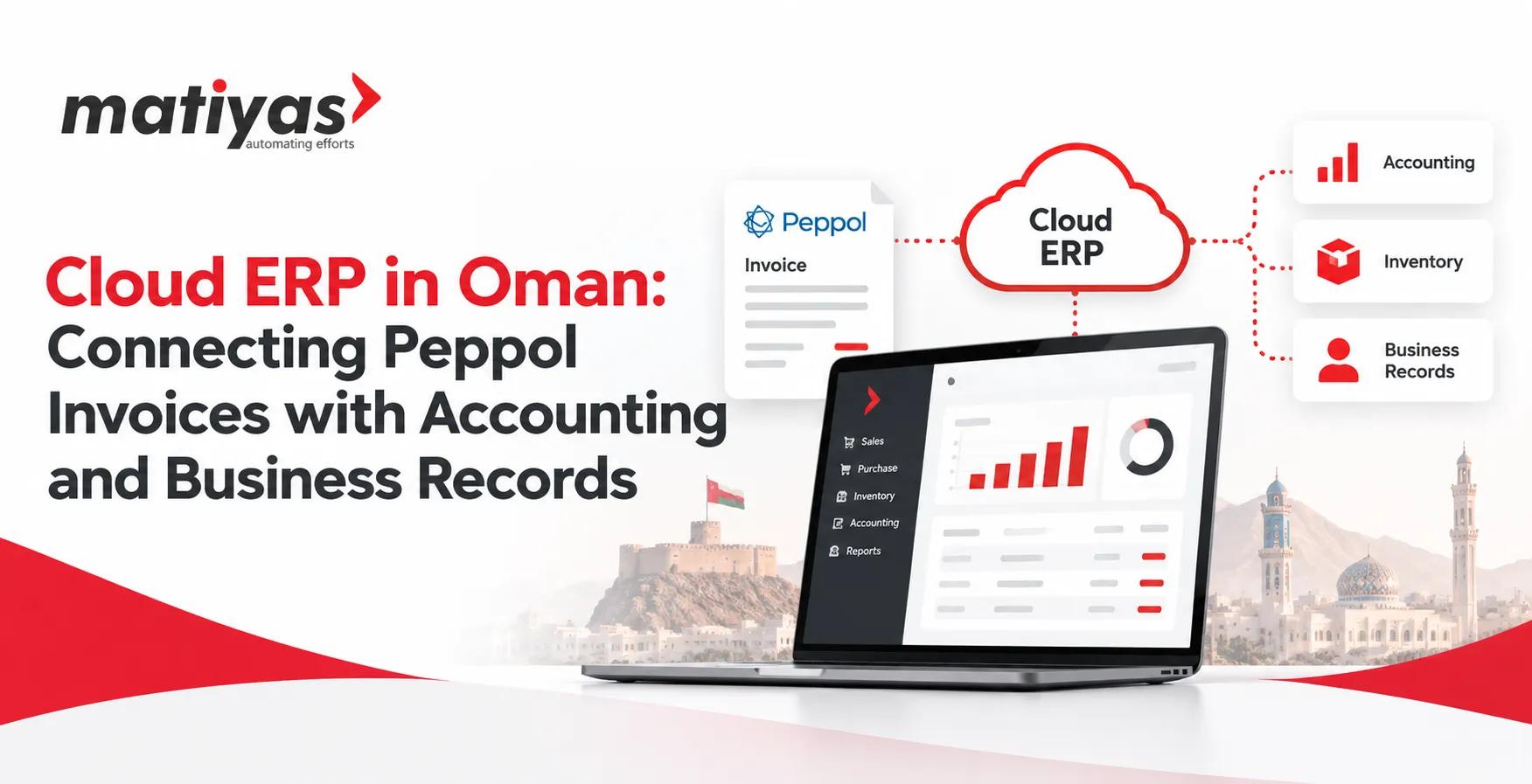
For businesses in Oman, preparing for electronic invoicing involves more than replacing paper invoices with digital documents. Finance teams must ensure that invoice information matches customer details, sales transactions, applicable tax treatment, inventory movements and accounting entries.
A cloud ERP system can help connect these processes within one operational environment. When appropriately configured and integrated with an eligible service provider, it can support the preparation, exchange, recording and tracking of electronic invoices without requiring finance teams to re-enter the same information across multiple applications.
What Does Cloud ERP Mean for Peppol E-Invoicing in Oman?
Cloud ERP is a business management system accessed over the internet that connects functions such as accounting, sales, purchasing, inventory and reporting.
For an Omani business, the objective is to connect these capabilities so that an invoice is not an isolated document. It becomes part of a traceable business transaction.
For example, when a distributor issues an invoice, the ERP should be able to connect it to:
The relevant customer account and tax identification details.
The original quotation or sales order.
The products, quantities and prices supplied.
Applicable tax codes and accounting accounts.
Inventory movements and delivery records.
The electronic invoice's transmission status and reference information.
The exact integration depends on the ERP platform, its configuration, the service provider and the applicable Oman technical specifications.
Why Invoice Integration Matters for Omani Businesses
Many trading companies, wholesalers, distributors and manufacturers manage invoices alongside separate spreadsheets, accounting tools, warehouse systems or customer databases.
This arrangement can create problems when the same transaction is recorded differently across departments.
1. Accounting entries do not match the original transaction
An invoice may contain an incorrect customer reference, item value or tax classification. If accounting staff enter the information manually, these errors can carry into the general ledger and financial reports.
An integrated ERP workflow can use approved sales transaction data to prepare invoice information and apply configured accounting rules. Validation checks can identify missing or inconsistent fields before submission.
2. Inventory and invoicing become disconnected
For a trading business, the invoice should correspond to the goods actually supplied. If inventory and accounting operate separately, the finance team may struggle to investigate differences between billed quantities, delivery records and stock movements.
Connecting sales, warehouse and accounting records creates a clearer audit trail from the order to the invoice.
3. Invoice status is difficult to track
A business needs to know whether an invoice has been prepared, validated, transmitted, delivered or rejected.
A PDF saved in a folder does not, by itself, establish that the corresponding structured invoice was successfully exchanged through the required process.
Integrating transmission acknowledgements and error messages into the ERP workflow can help finance teams identify exceptions and resolve them promptly.
How Cloud ERP Connects Peppol Invoices with Business Records
The integration should be designed around the complete transaction lifecycle rather than the invoice alone.
1. Sales order or business transaction
Customer, products, quantities, prices and commercial terms
2. Cloud ERP invoice preparation
Validate master data, tax treatment, totals and accounting mappings
3. Peppol-compatible integration
Map invoice data to the required format and transmit through an accredited service provider
4. Buyer exchange and OTA reporting
Handle delivery acknowledgements, validation outcomes and applicable tax-data reporting
5. ERP records and reconciliation
Maintain invoice references, receivables, inventory links and exception records
ERP Modules Required for Effective E-Invoice Integration
The quality of an integration depends on how well the underlying ERP records are maintained.
ERP component | Role in the invoicing workflow |
|---|---|
Sales and CRM | Maintains customer records, sales orders and agreed commercial terms. |
Accounting and finance | Records receivables, revenue, tax amounts and payment allocations. |
Inventory management | Connects invoiced quantities with stock and delivery transactions where applicable. |
Purchasing and accounts payable | Links supplier invoices with purchase orders, receipts and supplier accounts. |
Tax configuration | Applies the relevant tax categories, rates and invoice rules based on validated requirements. |
Integration and reporting | Tracks transmission results, errors, invoice references and reconciliation exceptions. |
These modules should share consistent master data and transaction references. Simply connecting an invoicing application to an accounting system is not enough if customer records, tax settings or item codes are inconsistent.
Oman-Specific Considerations: Fawtara, Peppol and Cloud ERP
Omani businesses should assess their readiness against the current requirements published by the Oman Tax Authority.
The OTA's Fawtara information describes a five-corner architecture and the use of service providers to support invoice exchange and reporting. Its service-provider guidance also explains that providers must obtain accreditation to perform the relevant role.
The following areas deserve particular attention:
Invoice data mapping: Ensure the ERP can map its customer, supplier, item, tax and transaction fields to the applicable Oman e-invoicing specifications.
Tax configuration: Review VAT-related settings, tax identifiers, invoice types and calculations with the finance team or tax adviser.
Service-provider connectivity: Confirm that the proposed provider is appropriately accredited for the relevant Oman requirements.
Error handling: Define how rejected invoices, incorrect customer details, duplicate submissions and corrections will be managed.
Record retention: Establish secure storage and retrieval procedures for invoices, related business records and transmission evidence.
Access and security: Apply suitable permissions, backups, monitoring and controls over sensitive financial information.
ERPNext and Odoo: Choosing the Right Integration Approach
ERPNext and Odoo are potential ERP platforms to evaluate when connecting accounting, sales, purchasing and inventory processes.
However, choosing an ERP platform does not automatically establish compliance with Oman's e-invoicing requirements. Businesses must verify the actual capabilities of their selected version and implementation.
A practical assessment should determine whether the solution can:
Produce the invoice data required by the applicable Oman specification.
Integrate with the chosen accredited service provider.
Validate mandatory fields before transmission.
Receive and store relevant acknowledgements and error information.
Link invoice records to accounting entries and source transactions.
Support controlled corrections, reconciliation and reporting.
These requirements may be addressed through standard functionality, a third-party integration or custom development. The implementation team should document which approach applies to each requirement and test the complete workflow before deployment.
Practical Example: An Omani Trading Company
Consider an illustrative trading company in Muscat that supplies electrical equipment to commercial customers.
A customer places an order for 40 units. The sales team confirms the order, the warehouse records the dispatch, and the ERP prepares the invoice using the relevant customer and product information.
Before transmission, the system checks that the required invoice fields are present and that the configured tax calculations and totals are consistent. The invoice data is then passed through the integrated service-provider workflow.
If the invoice is accepted and the exchange process returns the expected confirmation, the ERP retains the relevant references and links the invoice to the customer's receivable, sales order and delivery record.
If validation fails because of an incorrect customer identifier or missing field, the exception is routed to the responsible team for correction.
The business benefit is not simply faster invoice generation. It is the ability to investigate the entire transaction without reconstructing it from emails, spreadsheets and disconnected accounting records.
How Matiyas Solutions Can Support Your ERP Requirements
Matiyas Solutions provides ERP implementation, customization, integration and support services designed to help businesses connect operational processes and business information.
For organisations in Oman evaluating cloud ERP and Peppol e-invoicing, a structured project can include:
Reviewing existing accounting, sales and inventory workflows.
Assessing ERP data quality and identifying gaps in invoice records.
Defining integration requirements against the applicable Oman specifications.
Evaluating ERPNext or Odoo configuration and customization requirements.
Planning service-provider connectivity, testing, user training and ongoing support.
The precise scope depends on the business's current systems and the technical capabilities confirmed during assessment. Any Fawtara-specific integration should be validated against the latest OTA specifications and the selected provider's supported interfaces.
Conclusion
Cloud ERP in Oman can provide a practical foundation for connecting Peppol-compatible invoices with accounting, inventory, purchasing and customer records. The real value comes from maintaining consistent data and traceable transactions throughout the invoicing lifecycle.
Businesses preparing for Fawtara should review their invoice data, tax configuration, ERP integration options, service-provider arrangements and exception-handling processes before their applicable implementation date.
A well-planned integration can reduce repetitive data entry, improve reconciliation and make financial information easier to trace. These outcomes depend on sound configuration, reliable source data, appropriate testing and alignment with the applicable regulatory requirements.